
Australia is underutilising one of its greatest economic advantages: Australians embedded across the world, and those returning home.
At a time of global uncertainty and intensifying competition for talent, capital and ideas, we are failing to harness their skills and networks, both globally and within our own economy, says Global Australians CEO, Kate McQuestin.
“Australians are ambitious and excelling on the global stage. We should be proud of that, and more importantly, we should be using it.”
Australia is one of the most globally connected countries in the world, with more than four million Australians currently, or previously, embedded in key international markets.
Mobilising Australians abroad, alongside those who have returned home, represents a clear economic opportunity.
“Australia’s prosperity, security and influence are increasingly shaped beyond our borders. Capital flows, trade, innovation and talent mobility are driven by trusted relationships and embedded networks, and Australians are already inside them.
“Without coordination, this advantage remains diffuse and underutilised. With coordination, it becomes a strategic national capability. Success travels both ways. It is time to move from brain drain to brain circulation and recognise this as a national asset.”
Other countries, including Ireland, Israel, India, Singapore and New Zealand, are already investing in activating their global talent networks. Failure to act risks losing globally experienced Australians permanently, missing investment opportunities, and falling behind in critical sectors, ultimately impacting productivity and living standards.
Global Australians, formerly Advance, has repositioned as The Global Community for Australian Ambition. As an independent not for profit, it is focused on building the infrastructure and partnerships needed to scale this capability and deliver tangible outcomes in the national interest.
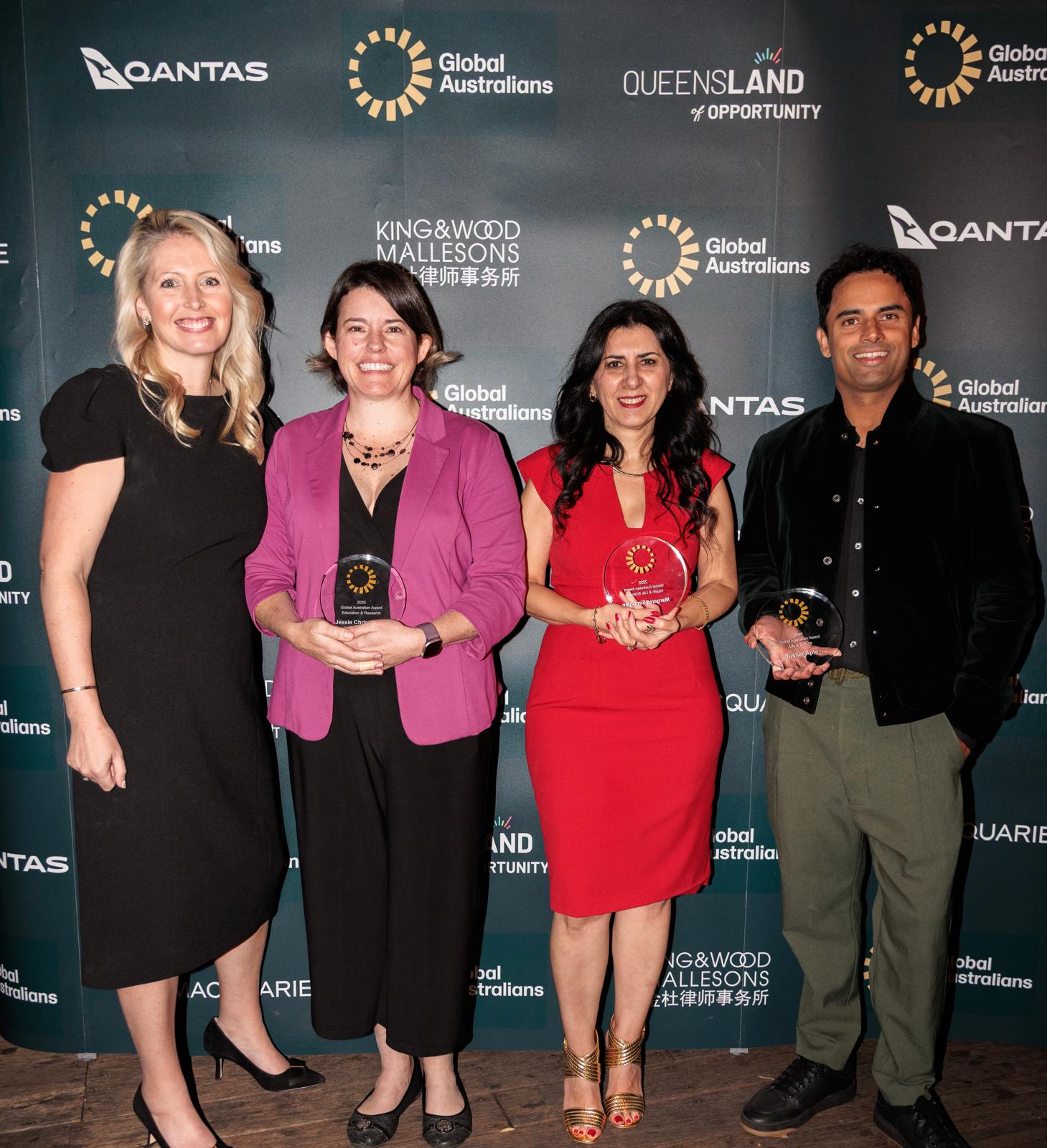
Its initiatives include a global digital platform connecting Australians by location, sector and career stage; a Career Pathway Program placing returning Australians into roles; the Global Australian Awards recognising high-impact individuals; the Global Leaders Circle convening senior decision-makers; and the Global Australian Report translating insights into policy-relevant intelligence.
“95 per cent of Australians overseas want to return at some point, yet only 15 per cent have a clear pathway home. At the same time, 68 per cent of returnees struggle to re-enter the workforce,” says McQuestin.
“That is why we have built a Career Pathway Program to convert global experience into real workforce outcomes.”
The economic case is significant. More than 350,000 roles remain unfilled across Australia at any given time, while skills shortages are estimated to reduce GDP by 2 to 4 per cent annually, equating to a 50 to 100 billion dollar impact.
“Together, this builds a living national platform, connecting talent, capital and opportunity globally,” McQuestin says. “It enables speed to impact for government priorities, supported by continuously updated global talent intelligence.
“It creates direct pathways to convert global experience into workforce outcomes, delivers real-time insight to inform policy, and builds the infrastructure needed for long-term national impact.”
The challenge is already visible in the labour market.
“Australia invests in developing global talent. Our people go offshore, work for the world’s best companies, and gain experience in far larger and more complex markets, then we waste it,” says Sharon Mackie Goh, Managing Partner of Talent Search Haus, a partner in the Global Australians Career Pathway Program.
“Research shows 20 per cent of returning executives leave within a year, and 30 per cent within two. But what I am seeing is worse: highly capable leaders who cannot get in the door at all. This is not just unfair, it is a loss to the country.”
With global shifts underway across AI, climate, energy and trade, the cost of inaction is rising.
“Only 14 per cent of Australian CEOs report revenue gains from AI, compared with 30 per cent globally. Yet we continue to hire from the same domestic networks,” Mackie Goh says. “This is not how you navigate uncertainty, it is how you fall behind.”
Currently, 75 per cent of ASX 200 CEOs have predominantly domestic experience.
“Too many of our best are coming home to find the door closed.”
Global Australians’ work has attracted support from leading organisations including Macquarie Group, Mallesons, Qantas and the Queensland Government.
The organisation has convened senior Australian leaders and global decision-makers across key hubs including Singapore, London, Sydney and New York this month, and recently brought together Australians in Paris, Bangkok, Hong Kong and Jakarta.

“What is clear around the world is that Australians are deeply committed to their country and want to contribute to its future. The opportunity now is to mobilise this globally, harness their experience and networks, and turn global success into national advantage at home," said McQuestin.
“If we get this right, we can transform a dispersed global population into a coordinated and powerful force, building enduring economic infrastructure that not only addresses today’s challenges, but strengthens our global competitiveness and leaves a lasting legacy for generations to come. Because ultimately, we go further together.”